A useful lease agreement checklist for landlords should verify more than whether common clause headings appear. It should confirm that the landlord has the complete document set, that names, dates, money terms, responsibilities, notices, riders, and signatures agree, and that any jurisdiction-specific requirement has been checked against a current authoritative source.
The 21-point landlord lease checklist
Use this checklist to review a residential lease before it is sent or signed. It is not a universal lease form. State and local rules, rent-regulation programs, subsidies, property type, building age, and the facts of the tenancy can change what is required or permitted.
| # | Item to verify | Minimum result before signing |
|---|---|---|
| 1 | Complete document set | Main lease, riders, addenda, exhibits, guaranties, and referenced rules are present |
| 2 | Correct version | Draft date, revision, page order, and later changes are clear |
| 3 | Parties and authority | Correct legal names, notice addresses, agent authority, and signatures are identified |
| 4 | Premises and included areas | Address, unit, parking, storage, furnishings, and shared areas match the deal |
| 5 | Tenancy type and term | Start, end, possession, renewal, and holdover language use consistent dates |
| 6 | Rent schedule and concessions | Stated rent, actual payment schedule, concessions, and increases do not conflict |
| 7 | Payment process | Due date, payee, permitted methods, delivery point, and receipt handling are clear |
| 8 | Security deposit | Amount, handling, permitted deductions, inspection, and return process are identified |
| 9 | Fees and other charges | Every fee, trigger, amount or formula, and frequency is listed for legal review |
| 10 | Utilities and services | Each party’s responsibility and any allocation method are stated |
| 11 | Occupancy and guests | Tenants, occupants, guests, and applicable approval procedures are distinguished |
| 12 | Pets and assistance animals | Pet rules are clear and disability-accommodation duties are not treated as pet exceptions |
| 13 | Maintenance and repairs | Reporting, emergency response, routine care, and owner duties are separated |
| 14 | Entry and access | Reasons, notice, coordination, emergencies, and showing access are addressed |
| 15 | Alterations and fixtures | Consent, contractors, restoration, and ownership of improvements are clear |
| 16 | Insurance and liability | Required coverage and responsibility language receive legal and insurance review |
| 17 | Subletting and assignment | Subleases, assignments, roommates, and short-term use have a defined process |
| 18 | Renewal and nonrenewal | Options, automatic renewal, notice windows, delivery, and rent changes are consistent |
| 19 | Default, cure, and termination | Events, notice, cure periods, early termination, and holdover are identifiable |
| 20 | Notices, disputes, and document changes | Delivery rules, dispute terms, amendments, and document priority are identified |
| 21 | Disclosures, riders, signatures, and operational handoff | Required forms are complete, all parties receive the signed set, and only verified terms enter operations |
For each item, record one of four results: confirmed , not found , conflict , or external verification required . Do not treat “the AI found a clause” or “the template has a heading” as confirmation.
1. Confirm the document set before reviewing the language
A lease review can be thorough and still useless if it analyzes the wrong or incomplete documents. Start with document control.
1. Complete document set
Collect every document intended to form the agreement:
- the main lease;
- all riders and addenda;
- property or building rules incorporated by reference;
- pet, parking, storage, utility, smoking, or appliance addenda;
- guaranties;
- disclosure forms;
- move-in condition forms;
- exhibits and schedules; and
- any renewal, amendment, or side agreement that will control the tenancy.
Search the main lease for phrases such as “attached,” “incorporated,” “exhibit,” “schedule,” “rider,” and “addendum.” Every referenced document should either be present or marked for follow-up.
2. Correct version and page order
Confirm the draft date or version, total page count, page order, property and tenant identifiers, and whether tracked changes or comments remain. If several drafts circulated, identify the one intended for signature and preserve the revision history separately.
Handwritten edits, initials, electronic fields, and replacement pages deserve individual review. A corrected page inserted into the wrong draft can quietly restore language the parties thought they removed.
3. Parties and signing authority
Check the full legal names and notice addresses of the owner, landlord, tenant, any management agent, and any guarantor. Confirm that an entity name matches the party actually entering the agreement and that the signer has authority to sign for the entity.
Separate tenants , who are parties to the lease, from other approved occupants . Do not assume every adult occupant must be treated identically in every jurisdiction or housing program; confirm the correct structure for the property.
2. Verify the property, term, and every money term
Money and date errors are easy to copy into reminders, rent schedules, notices, and later renewals. Check the controlling words before turning them into operations.
4. Premises and included areas
Verify the street address, unit, municipality, and any included parking space, storage area, yard, garage, furnishings, or appliances. If the tenant may use common areas or amenities, confirm whether the lease or building rules describe access, hours, reservations, charges, and closures.
Check whether the document promises anything that does not exist at the property or omits something included in the negotiated deal.
5. Tenancy type, term, and possession
Record:
- fixed term or month-to-month;
- lease start and end dates;
- possession or move-in date if different;
- conditions that must occur before possession;
- renewal or extension structure;
- holdover language; and
- what happens if delivery of possession is delayed.
Do not calculate a deadline until you identify the event that starts the clock. “Thirty days before expiration,” “thirty days before renewal,” and “thirty days after notice” are not interchangeable.
6. Rent schedule and concessions
Find the stated rent everywhere it appears: cover page, term sheet, rent paragraph, concession rider, renewal option, payment schedule, and signature summary. Keep these concepts separate:
- legal or contract rent;
- amount actually due each period;
- free-rent or discounted periods;
- one-time credits;
- stepped or scheduled increases; and
- conditions that cancel or recapture a concession.
If two provisions produce different amounts, mark a conflict. Do not choose the lower or higher figure based on what seems reasonable.
7. Payment process
Confirm the due date, payee, address or portal, accepted payment methods, treatment of weekends or holidays, partial-payment language, returned-payment procedure, and any receipt requirements. Verify the current law before assuming a lease may require a particular payment method or waive a receipt obligation.
8. Security deposit
Identify the amount, due date, handling method, required account or notice, interest treatment if applicable, move-in inspection process, permitted deductions, itemization procedure, return deadline, and delivery address after move-out.
These rules vary significantly. The lease is the place to find the parties’ words; it is not proof that the amount or procedure is lawful.
9. Fees and other charges
Create one list containing every late fee, returned-payment charge, application or screening charge, pet charge, parking fee, amenity fee, utility charge, move-in or move-out fee, replacement-key charge, administrative fee, legal fee, and reimbursement obligation.
For each item, record:
- amount or calculation formula;
- triggering event;
- frequency;
- grace or notice language;
- whether it is described as rent; and
- the current authority used to verify it.
If the tool or reviewer cannot trace a charge to the agreement, write “not found.” Do not invent a business rule to complete the table.
10. Utilities and services
State who handles electricity, gas, heat, hot water, water, sewer, internet, trash, recycling, snow, landscaping, pest service, and any shared building service. If the tenant pays an allocated share rather than a direct meter, identify the calculation, billing information, timing, and dispute procedure.
Check the actual property setup. A perfectly written utility clause can still be operationally wrong if the unit is not separately metered as the lease assumes.
3. Separate property rules from non-waivable responsibilities
A lease should describe expectations clearly, but it cannot make every responsibility legally transferable. Use current local authority for habitability, repairs, access, occupancy, and accommodation questions.
11. Occupancy and guests
Identify named tenants, approved occupants, guest rules, procedures for adding or replacing an occupant, and any occupancy standards. Avoid using a generic guest limit as a substitute for understanding local roommate, family-occupancy, succession, or overcrowding rules.
12. Pets and assistance animals
Review ordinary pet rules for permitted animals, approvals, damage, cleanup, and lawful charges. Keep disability-related accommodation requests outside the ordinary pet-policy workflow.
HUD explains that an assistance animal is not a pet and that housing providers may need to make a reasonable accommodation to pet restrictions when the applicable conditions are met. A “no pets” paragraph does not answer an assistance-animal request. Use HUD’s current assistance-animal guidance and qualified advice for the facts involved.
13. Maintenance and repairs
Distinguish:
- how the tenant reports ordinary and emergency conditions;
- which contact method should be used;
- routine care assigned to the tenant;
- owner or manager repair duties;
- responsibility for damage caused by occupants or guests;
- access coordination;
- appliance or filter responsibilities; and
- how completion is documented.
Do not rely on language that purports to waive a duty that current law makes non-waivable. Check the property’s jurisdiction and housing program.
14. Entry and access
Find every provision about repairs, inspections, showings, emergencies, lender or insurer visits, and abandonment. Record the required notice, delivery method, permitted hours, coordination process, and any exception.
Summaries often flatten “reasonable notice except in an emergency” into “landlord may enter.” Quote and review the complete sentence, not only the apparent permission.
15. Alterations and fixtures
Clarify which changes require written consent, who may perform work, licensing or insurance expectations, approval of plans, restoration at move-out, and ownership of installed fixtures. Keep ordinary alterations separate from disability-related modification rights.
16. Insurance, indemnity, and liability
Identify renter-insurance requirements, coverage amounts, proof and renewal procedures, loss allocation, subrogation language, indemnity clauses, negligence language, and liability limitations.
Send this section to the appropriate insurance and legal professionals. A clause can affect coverage, conflict with a policy, or attempt to shift responsibility that the law does not allow the landlord to shift.
17. Subletting, assignment, roommates, and short-term use
Locate every restriction or procedure affecting subleases, assignments, replacement tenants, roommates, licenses, and short-term rental activity. Confirm required consent, application steps, fees, response timing, and continuing responsibility.
The answer can depend on building size, locality, rent regulation, housing program, and intended use. Do not convert a template’s default setting into a universal rule.
4. Test how the lease changes and ends
Landlords often focus on move-in terms and skim the language that governs renewal, default, and termination. Those provisions deserve a separate pass.
18. Renewal, nonrenewal, and automatic renewal
List every renewal option, automatic-renewal clause, notice window, response period, delivery method, rent-change term, holdover result, and required form. Then compare those terms to the property’s current legal and regulatory requirements.
Do not merge the lease expiration date with the deadline to offer, accept, reject, or deliver a renewal. They are different events.
19. Default, cure, early termination, and holdover
Identify what the agreement calls a default, which notice and cure provisions apply, how early termination works, what happens after a casualty or inability to deliver possession, and how holdover occupancy is treated.
AI can locate and organize these clauses. It should not decide whether a default occurred, whether a notice is legally sufficient, or whether termination is available on disputed facts.
20. Notice, dispute, and document-change rules
Check:
- notice addresses and permitted delivery methods;
- when notice is considered received;
- email or electronic-consent language;
- attorney-fee provisions;
- dispute, mediation, arbitration, jury, venue, and governing-law language;
- waiver and severability clauses;
- the process for changing the agreement; and
- which document controls if terms conflict.
Have qualified counsel review any clause that affects rights in a dispute. Do not assume an agreement can make a prohibited term enforceable by calling it a waiver.
5. Verify disclosures, signatures, and the handoff into operations
The final pass is not clerical. Missing attachments, acknowledgments, or a reliable executed copy can undermine an otherwise careful review.
21. Disclosures, riders, signatures, and delivery
Build a jurisdiction-specific attachment list. Confirm that each required form is current, complete, attached, signed or acknowledged where required, and delivered using an allowed method.
One federal example is lead-based paint disclosure. EPA says landlords and managers must provide specified information before a prospective renter signs a lease for most pre-1978 housing, subject to listed exceptions. EPA also identifies the pamphlet, known-hazard information, available reports, warning statement, signatures, and retention requirements. Check the current EPA lead-disclosure page rather than copying an old disclosure from another property.
Before release for signature, verify:
- every required party and guarantor has a signature field;
- entity titles and signing capacity are correct;
- all blanks are completed or intentionally marked;
- initials and acknowledgments are present where required;
- the final PDF includes every attachment; and
- each party can access and retain the completed agreement.
After signing, preserve the executed version as the system of record. Move only verified terms into rent schedules, reminders, maintenance responsibilities, insurance follow-up, renewal calendars, and document-retention tasks.
How to use AI with this landlord lease checklist
AI is most useful as an inspectable first pass. Use three separate passes instead of asking, “Is this lease compliant?”
Pass 1: Exact extraction
Ask the system to fill the checklist using only the supplied documents.
Review only the attached lease, riders, addenda, amendments, exhibits, and guaranties. For each of the 21 checklist items, return one status: confirmed, not found, conflict, or external verification required. Give the document name, page, section, and a short supporting quotation. Do not infer missing facts or decide whether a provision is legal.
Pass 2: Conflict and omission review
Ask the system to challenge its first pass.
Re-read the complete document set only to find contradictions, missing referenced attachments, inconsistent names, dates, amounts, notice periods, defined terms, cross-references, and signature requirements. Compare the main lease with every later rider or amendment. Do not silently choose which provision controls.
Pass 3: Operational handoff candidates
Turn confirmed terms into a review queue—not automatic actions.
Using only items marked confirmed, list candidate rent dates, notice windows, renewal dates, document deadlines, insurance follow-ups, maintenance responsibilities, and recurring tasks. For every candidate, show the exact source and triggering event. Do not schedule, message, update a record, or calculate a disputed deadline without human approval.
This structure is safer because extraction, interpretation, and action do not happen in one opaque step.
NIST’s Generative AI Profile identifies risks including confabulation, data privacy, harmful bias, information security, and human-AI configuration. A fluent answer can still be invented or incomplete. Check the source passage and the upload provider’s data practices before relying on the result. See the NIST AI Risk Management Framework .
What AI should not decide from the lease alone
Do not delegate these conclusions to an unsupported model output:
- whether the unit is rent regulated or exempt;
- the legal or regulated rent;
- whether a fee, waiver, deposit, entry rule, or termination term is enforceable;
- whether a required disclosure is current and complete;
- whether a party satisfied a notice or cure requirement;
- whether a disability-related accommodation or modification must be granted;
- whether a default, abandonment, nuisance, or lease violation occurred;
- which disputed document controls;
- whether to send a notice, change a record, withhold money, or begin a legal process; or
- what an attorney, court, agency, insurer, or licensed professional would conclude from additional facts.
The AI can organize questions and sources. The responsible human makes the decision with the right authority and professional input.
Extra checks for New York and NYC landlords
New York illustrates why a national checklist must include an external-verification column.
The New York Attorney General’s current tenant guide says leases should identify the premises, names and addresses of the parties, rent and due dates, rental duration, occupancy conditions, and each party’s rights and obligations. It also lists lease provisions that New York law does not allow. Review the current Residential Tenants’ Rights Guide instead of assuming a template is valid because it was used before.
For rent-stabilized apartments, New York State Homes and Community Renewal publishes current lease riders, addenda, renewal forms, fact sheets, and procedures. HCR says owners must attach and serve its lease rider for NYC rent-stabilized vacancy and renewal leases. Use the current HCR leases page , confirm the unit’s status separately, and obtain qualified advice when the facts or rent history are disputed.
Where Lease AI fits
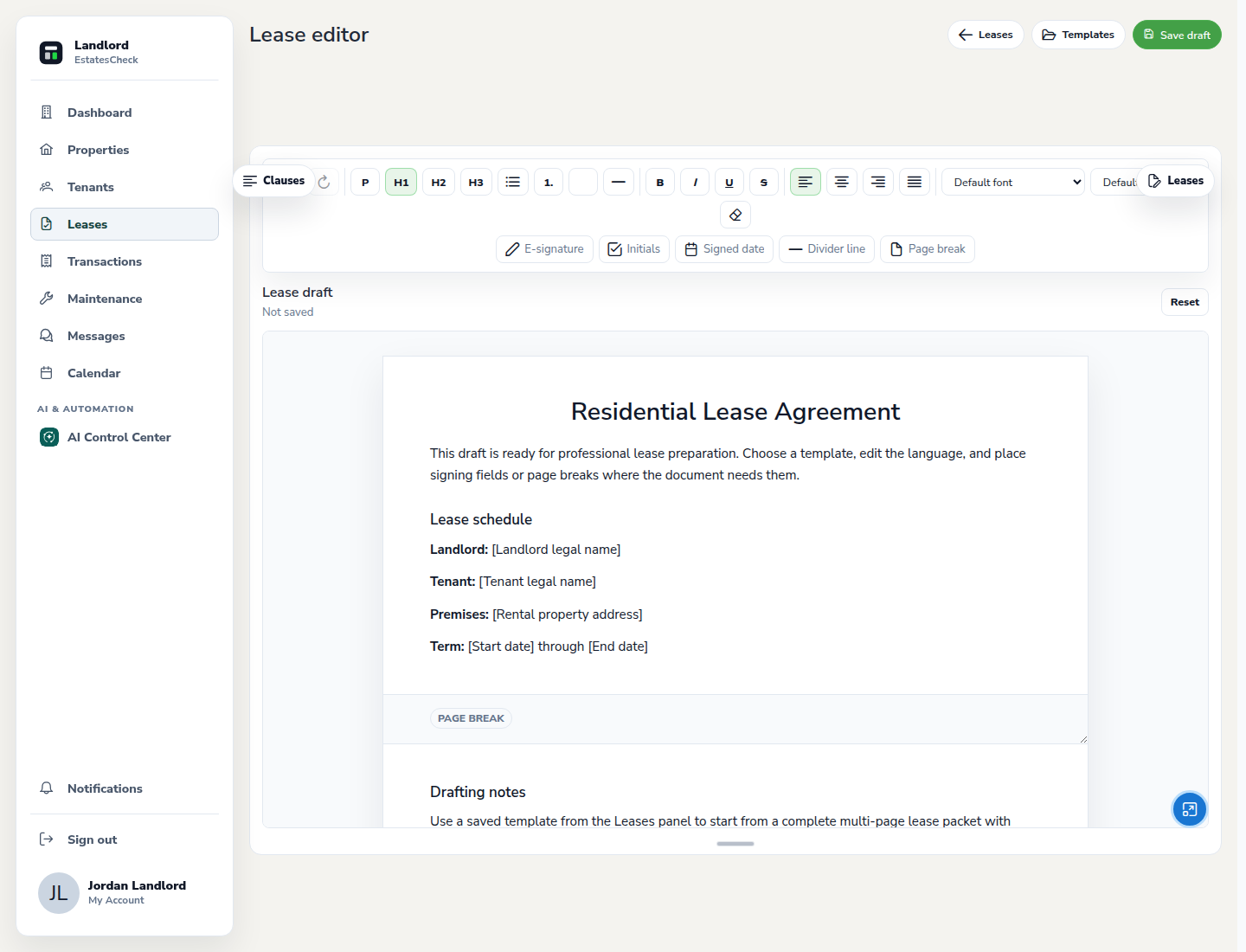
For the underlying product workflow, see How to create, manage, and sign a lease and 7 Ways NYC Landlords Can Stay Organized . In the current EstateCheck lease editor, Lease AI works from a permanently saved draft and can use selected lease text to answer a question or propose a draft change. A proposal does not change the draft until the landlord explicitly applies it; the landlord can dismiss it or undo an applied AI change. This is drafting assistance, not legal review or a compliance determination.
Frequently asked questions
What should every residential lease agreement include?
At minimum, a residential lease should clearly identify the parties and premises and address the term, rent, payment process, deposit, utilities, occupancy, property rules, maintenance, access, renewal, default, termination, notices, and signatures. Required disclosures, riders, wording, and permitted terms depend on the jurisdiction and property.
Is a lease checklist the same as a lease template?
No. A template supplies proposed contract language. A checklist tests whether the complete agreement addresses the relevant facts, contains all referenced documents, avoids internal conflicts, and has been reviewed against current external requirements. A landlord can use a good template and still complete it incorrectly.
Can AI review a residential lease for a landlord?
AI can extract terms, locate clauses, compare versions, find possible conflicts, and generate follow-up questions. It cannot safely establish legality, regulated status, enforceability, or the facts of a dispute without reliable current sources and human judgment. Require a page and section for every important answer.
What is the most commonly missed part of a lease review?
The biggest process failure is reviewing only the main lease. Riders, addenda, amendments, exhibits, building rules, guaranties, disclosures, and signature pages can change the deal or reveal that the document set is incomplete. Confirm the inventory before reviewing individual clauses.
How often should a landlord review a lease template?
Review it before using it for a different jurisdiction, property type, housing program, or material business change, and whenever relevant law or official forms change. Also review the completed agreement for every tenancy; an updated template does not prevent names, dates, amounts, attachments, and selections from being entered incorrectly.
Should a landlord automatically add AI-extracted dates to a calendar?
No. First verify the exact clause, triggering event, applicable rider or amendment, delivery rule, and any controlling legal requirement. Add the date only after a person confirms the calculation. Preserve the source language with the reminder so the deadline can be checked later.
A strong landlord lease review produces more than a checked box. It produces a complete signed document set, an explicit list of unresolved questions, verified money and date terms, current disclosures, and a clean handoff into property operations. Use AI to make that review easier to inspect—not to skip it.
This article provides general information and is not legal advice. Lease requirements and landlord-tenant rules vary by jurisdiction, housing type, program, facts, and effective date.