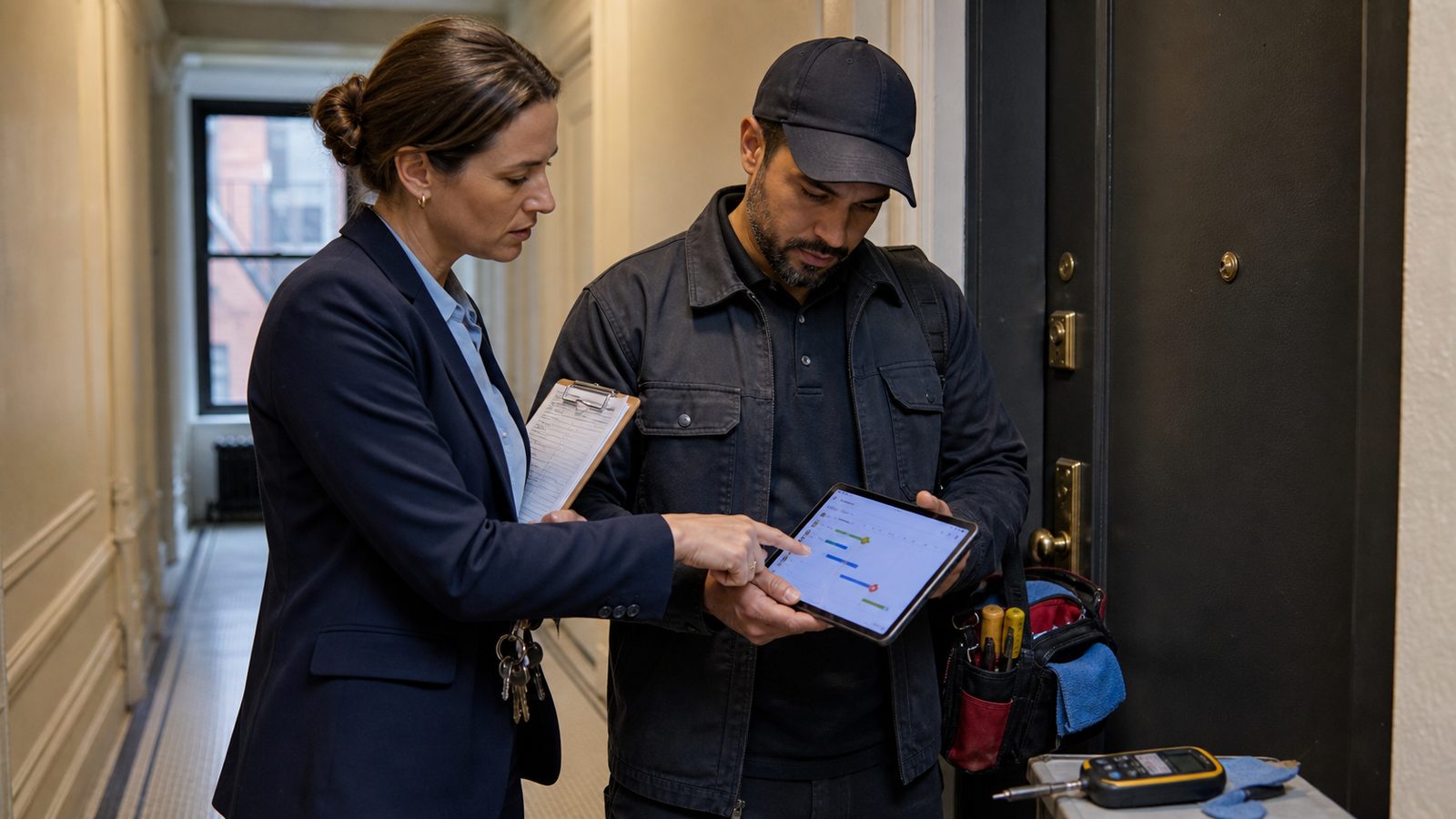
Rental maintenance management software should create one complete record from the first resident report through verified completion. The system needs more than a request form: it should preserve urgency, contact attempts, access instructions, assignment, estimates, approvals, vendor updates, photographs, invoices, resident confirmation, and any reopened work.
The maintenance record a property manager needs
| Stage | Required information | Proof the stage is complete |
|---|---|---|
| Intake | Property, unit, reporter, condition, location, time, description, media | Request is attached to the correct unit and acknowledged |
| Triage | Urgency, safety concerns, habitability indicators, affected areas, next response | Named decision-maker and response path |
| Access | Occupant contact, permission, keys, pets, entry constraints, appointments | Confirmed access plan or documented attempts |
| Assignment | Responsible staff or vendor, scope, priority, target date | Assignee acknowledges the work |
| Approval | Estimate, owner or manager approval, spend limit, change order | Approved scope and amount are recorded |
| Execution | Visits, labor, materials, findings, photographs, status changes | Technician or vendor records work performed |
| Financial link | Invoice, purchase order, allocation, payment status | Cost ties to the work and correct property |
| Verification | Resident follow-up, manager review, final media, remaining issue | Closure is confirmed, not merely claimed |
| Reopen and history | Recurrence, warranty, follow-up assignment, prior repair | New work preserves the original timeline |
If these stages live in email, text messages, paper invoices, and separate accounting software, the team must reconstruct the story when an owner, resident, insurer, agency, or contractor asks what happened.
Seven maintenance capabilities to test
1. Structured intake without blocking urgent contact
Residents should be able to submit a clear request with photographs and contact details. The system should also show urgent-contact instructions rather than implying that a portal is monitored every second. Test duplicate reports for the same condition and reports that affect multiple units.
2. Triage that distinguishes urgency and scope
A free-text description is not a triage system. The team needs priority, affected service, safety indicators, responsible reviewer, and a documented next action. Test whether the product can escalate after no acknowledgment or missed target.
3. Access coordination on the same timeline
The repair record should preserve who contacted whom, the offered appointment windows, permissions, key instructions, pets, failed access, and rescheduling. Do not place sensitive access information in a broadly visible note field.
4. Assignment and vendor control
Test internal staff, preferred vendors, emergency vendors, reassignment, estimates, approval limits, change orders, insurance documents, and work acknowledgment. A vendor portal is useful only if it limits the vendor to the appropriate record.
5. Mobile field updates
Technicians should be able to see scope and access instructions, then record arrival, diagnosis, work, materials, photographs, and remaining issues from the field. Test weak connectivity and the handling of large media files.
6. Cost and invoice linkage
The work order, purchase order, invoice, property allocation, approval, and payment should remain connected. If accounting is separate, test the integration and the fallback export. A repair marked complete without its final cost is an incomplete operating record.
7. Verified closure and recurrence
Closing a work order should require the relevant evidence for that workflow. The system should support resident follow-up, management review, a remaining-condition note, and reopening without destroying the first repair history.
How established products describe maintenance
Buildium
Buildium publishes task and work-order management, maintenance projects and templates, reports, billing, staff calendars, time tracking, unit-turn automation, inspections, and a maintenance contact-center option. Some inspection and service economics vary by plan. Review Buildium’s current pricing and maintenance scope .
DoorLoop
DoorLoop publishes resident maintenance requests, work orders, vendor records, vendor portals, calendars, communication, advanced tracking, vendor payments, and automated workflows depending on the plan. Review DoorLoop’s plan comparison .
AppFolio
AppFolio publishes work-order management, inspections and unit turns, purchase orders and inventory, mobile tools, scheduling, automated billing, and additional automation or contact-center services. Review AppFolio’s maintenance capabilities .
Rent Manager
Rent Manager publishes service issues, scheduling, work orders and billing, inspections, make-ready boards, vendor management, mobile tools, custom workflows, technician mapping, video inspections, and optional contact-center and communications services. Review Rent Manager’s bundles .
Propertyware
Propertyware publishes inspections, work orders, maintenance projects, vendor portals, tenant and owner portals, and an optional maintenance contact center. Its pricing page lists the contact center separately from the core package. Review Propertyware’s pricing .
These lists identify demo topics. They do not show how well the team can complete a repair.
Use one NYC repair scenario in every demo
Report water entering a bathroom ceiling on a weekend. The upstairs occupant is not responding, the building has a preferred plumber, and the owner requires approval above a set amount.
Ask the vendor to show:
- How the downstairs resident reports the condition and receives acknowledgment.
- How the manager records urgency, affected units, and immediate instructions.
- How both apartments and the common building record connect to the issue.
- How contact and access attempts are preserved.
- How the plumber receives only the necessary information.
- How an estimate and change order are approved.
- How the technician records the source, work performed, and photographs.
- How the invoice posts to the correct property and work order.
- How both residents receive appropriate updates.
- How the manager verifies drying, follow-up work, and final closure.
- How a recurring stain two weeks later reopens or links to the original issue.
- How the complete timeline and attachments export.
This scenario exposes whether the product manages a repair or merely stores tickets.
Maintenance metrics that can improve operations
Measure only what supports a decision. Useful measures may include:
- time from report to acknowledgment;
- time from acknowledgment to assignment;
- time waiting for access, approval, parts, or vendor action;
- open urgent requests;
- work past target date;
- repeat requests by property, unit, system, or vendor;
- completion without invoice or evidence;
- resident-confirmed closure rate; and
- cost by property, system, vendor, and repair type.
The software should show the underlying records behind a metric. A fast “close time” is harmful if staff close requests before the condition is resolved.
Maintenance software and NYC compliance records
Maintenance software can support a compliance workflow by preserving the controlling notice or inspection, the observed condition, assignments, access attempts, contractor records, photographs, invoices, certifications, filings, and agency outcome. It should not label an item “compliant” merely because a work order is closed.
Keep these milestones separate when they apply:
- the physical condition was corrected;
- an underlying cause was addressed;
- required evidence was collected;
- a response, certification, or filing was submitted;
- the receiving party or agency accepted it; and
- the public or internal record reflects closure.
Consult the exact official record and qualified professionals for the property’s requirements.
Where EstatesCheck fits
EstatesCheck’s published early-access scope includes maintenance requests, tenant messaging, notifications, documents, reminders, inspections, property records, and supported property or violation data. That combination can be useful when a small NYC team wants the repair and its property context together.
Buyers should still test assignment, permissions, vendor handling, cost linkage, exports, and the exact closure record enabled for the account. They should not assume a contact center, vendor payment, accounting integration, or automated agency closure exists unless demonstrated. Review the EstatesCheck feature matrix .
Frequently asked questions
What is property maintenance management software?
It is software that organizes repair intake, triage, assignment, access, vendor work, cost, communication, evidence, and completion for rental properties. A resident request portal is one component, not the complete workflow.
Should tenants be able to submit maintenance requests online?
Online intake can improve detail and preserve a timestamp, but the product should also communicate the correct urgent-contact path. The landlord remains responsible for reviewing and acting through the appropriate process.
What should be attached to a completed work order?
The necessary record depends on the job, but it may include the original report, contact and access history, approved scope, technician notes, before-and-after photographs, parts or materials, invoice, resident follow-up, and any separate filing or acceptance evidence.
Can maintenance software prove an NYC violation is closed?
Not by itself. It can preserve work and filing evidence, but agency closure is a separate milestone that must be verified through the controlling official record.
Buy the complete repair record
The strongest maintenance software makes the next action obvious and the completed history defensible. Test a difficult repair from first report through recurrence. If the team must rebuild the story from texts, email, and invoices, the software has not solved the maintenance workflow.
Compare broader platforms in Best NYC Property Management Software , then run the Property Management Software Demo Checklist .
This article provides general product and operational information, not legal, accounting, engineering, or emergency-response advice.